Giants
Le Morte d'ArthurGiants are recurring adversaries in the romance, appearing in private rescues and on the scale of international war. Their exceptional size and strength make them tests of knightly prowess, but the stories do not give them a single role: some are instruments of an invading emperor, while others terrorize local people. Their defeats restore safety, and their remains or the places of their crimes can become public signs of the victory.
Identity and Place in the Narrative
The text treats giants as powerful opponents, not as a single organized people. A giant is described in the index as Jubance, and other named giants include Galapas and Taulurd; the episodes show them encountered individually or among military forces. Their appearances are spread across the narrative, from King Arthur’s campaigns to the adventures of Sir Launcelot, making them a recurring measure of how a knight’s courage fares against an adversary beyond ordinary human scale.
Their place in battle is not always the same. The Roman emperor Lucius has fifty giants, described as born of fiends, assigned to guard his person and break the front of King Arthur’s battle line. Elsewhere a giant enters a fight already underway and inflicts losses among the knights. In rescue tales, by contrast, giants act as local tyrants whose defeat releases people held in captivity. The shared feature is formidable force; the consequences depend on who commands or confronts it.
Arthur’s Encounters and the Roman War
During the campaign in France, King Arthur travels in secret with Sir Kay and Sir Bedivere to Saint Michael’s Mount. A widow warns him that a giant has murdered a duchess, the wife of Sir Howell, Duke of Brittany, and says the monster has defeated fifteen kings. Arthur nevertheless approaches, finding the giant at supper and learning of the danger to the people around him. He challenges the giant and fights him alone; after the struggle carries them down the hill, his companions help free the king, and Arthur orders Sir Kay to take the giant’s head to Sir Howell as proof that the enemy is dead. Arthur also directs that a church to Saint Michael be built on the hill. The encounter ends not only in the defeat of a feared opponent, but in a public remedy for the harm done to the country.
The Roman campaign places giants on a larger military scale. Lucius assembles allies and an army, and his fifty giants are meant both to protect him and to break Arthur’s battle line. In the fighting, Arthur encounters Galapas, a giant of enormous stature, and kills him with Excalibur. The narrative singles out this deed within a battle otherwise too extensive to recount fighter by fighter: Arthur seeks out the thickest fighting to aid his people, and the giant’s death forms part of the defeat of Lucius and the rout of the Roman army. Giants here are not merely obstacles to individual knights; they are part of the emperor’s strategy, and their defeat belongs to the outcome of a kingdom-wide conflict.
Rescue and the Restoration of Safety
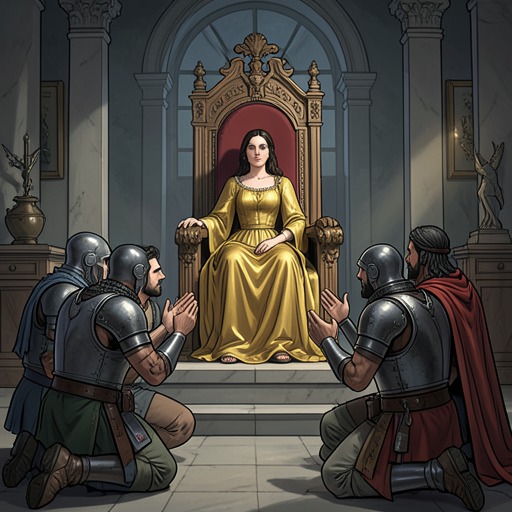
In another adventure, Sir Launcelot encounters two armed giants carrying clubs. He turns aside one blow with his shield and defeats the first giant, then pursues and kills the second as it flees. Their deaths open the way into Tintagil Castle, where sixty ladies and damsels kneel to thank God and their deliverer. They explain that most have been prisoners there for seven years, forced to work in silk for their food, and that many knights had attempted the rescue without success. Launcelot identifies himself, gives the castle’s treasure to the women as compensation for their hardship, and asks that its rightful owner receive what is due. In this episode, the test of strength concludes in a concrete restoration: captives are released, and the goods are not treated as the victor’s spoils.
The Tintagil episode also connects the adventure to the earlier history of the castle. The women identify it as the property of a duke who had married Igraine, before Uther Pendragon married her and fathered Arthur. Launcelot understands to whom the castle belongs and leaves the women in safety. The scene thus couples the defeat of giants with the recovery of a place whose history reaches back to Arthur’s own origins; rescue, rightful ownership, and the larger royal story meet in one location.
Collective Threat and Named Opponents
The battle in which Sir Gawaine and his companions fight alongside other knights shows a giant entering amid a shifting contest. Jubance emerges and attacks the knights, killing Sir Gherard of Wales. Gawaine has initially refused to move to support Sir Florence’s smaller force because he judges it strong enough, but the arrival of additional enemies changes the scale of the fight. The knights rally, and the battle ends in their victory, though Gawaine’s child and ward, Sir Chestelaine, is also killed. The giant’s presence marks the danger of a conflict that can turn suddenly against the knights, while the losses prevent victory from being an uncomplicated triumph.
The index preserves the names of further giants, including Taulurd, but the evidence here supplies no account of his actions. Such entries confirm that giants recur beyond the fully narrated encounters, while the fuller episodes establish the pattern: a giant’s force creates an acute trial, and the narrative measures the result through the safety or loss of those caught in its path.
Narrative Significance
These encounters vary in scale, from a rescue at a castle to the collision of armies. A giant can be an emperor’s weapon, a battlefield threat, or the source of a community’s long captivity. Accordingly, defeating one may contribute to military victory, avenge a murdered duchess, or release prisoners who have endured years of confinement. The reward is not always personal: Arthur shares treasure with the people and orders a church built after his victory, while Launcelot gives the Tintagil treasure to those he frees and recognizes the castle’s rightful ownership.
The repeated encounters make physical prowess visible through its consequences. Strength alone belongs to the giant; the knights’ actions are distinguished by what victory is used to accomplish. By placing the giant’s defeat alongside the protection of communities, care for survivors, and the recovery of rightful order, the romance turns a contest of force into a test of public responsibility.